Proto-Santa: Toward a Reconstruction of the Pre-Christian Midwinter Figure
A hypothesis in comparative mythology
Authors Note: This post was inspired in part by my friend Benjamin’s article he published this morning, The Christ Meme. A great personal exploration into Christian mythology and how we might relate to it now.
Introduction
The modern Santa Claus is, by all documented accounts, a 19th-century American literary invention. Clement Clarke Moore’s 1823 poem “A Visit from St. Nicholas” gave us the reindeer, the chimney descent, the jolly rotundity. Thomas Nast’s illustrations in Harper’s Weekly codified the visual. Coca-Cola’s 1930s advertising campaigns burnished it into the red-suited icon recognized worldwide. Behind this literary figure stands the historical St. Nicholas of Myra—a 4th-century Christian bishop in Lycia (modern Turkey) renowned for anonymous gift-giving—whose feast day (December 6) migrated north with Christianity and whose Dutch diminutive, Sinterklaas, became our “Santa Claus.”
This is the standard scholarly account, supported by historians like Stephen Nissenbaum (The Battle for Christmas, 1996) and Gerry Bowler (Santa Claus: A Biography, 2005). It is correct as far as it goes.
But it does not explain everything. Certain motifs in the Santa complex resist easy derivation from either St. Nicholas hagiography or 19th-century literary invention:
The hearth as focal point. The fireplace is central to the Santa transaction—stockings hung there, gifts appearing there, offerings left there. This hearth-focus predates Moore and has no basis in Mediterranean Nicholas traditions. Nicholas threw gold through windows; somehow the tradition migrated to the fire.
The midwinter solstice timing. Nicholas’s feast is December 6, not the solstice. The gravitational pull toward December 21-25 comes from elsewhere.
The shadow-companion. Across Central Europe, Santa/Nicholas travels with a terrifying punisher—Krampus, Knecht Ruprecht, Père Fouettard—who predates the Christianization of these regions.
The naughty-or-nice judgment. Nicholas, in his legends, is generous to all who suffer. The moral-evaluation framework derives from a different logic entirely.
The far-north location. Nicholas was a Mediterranean bishop. The Arctic associations have no basis in his cult.
These anomalies suggest deeper strata. This essay proposes that behind the Christian overlay lies fragmentary memory of an older figure—or complex of figures—associated with midwinter judgment, liminality, and fierce generosity. I call this hypothetical reconstruction “Proto-Santa,” using the prefix in the same sense comparative linguists use “Proto-Indo-European”: not a proven historical entity, but a reconstruction from convergent evidence.
Methodological Note
This essay employs the comparative method used in Indo-European studies and the history of religions. The approach involves:
- Identifying anomalies: Elements in the documented tradition that cannot be explained by the standard transmission narrative.
- Surveying parallel traditions: Similar motifs in related or neighboring cultures, assessed for possible common origin versus independent development.
- Proposing a reconstruction: A hypothetical source that would explain the observed pattern, clearly marked as hypothesis rather than established fact.
- Stating falsifiability conditions: What evidence would disprove the hypothesis.
This method has limitations. As anthropologist Edmund Leach warned about Mircea Eliade’s comparative work, one can always find “snippets of exotic ethnography” to support a predetermined thesis. The challenge is distinguishing features specific enough to suggest historical connection from those universal enough to arise independently.
I have tried to apply two tests: (1) Is the parallel specific and strange—something that wouldn’t obviously arise from common sense or universal human experience? (2) Is there a plausible transmission mechanism—geographic, linguistic, or cultural continuity that could carry the motif across traditions?
The hearth as supernatural transaction point, combined with midwinter timing, household judgment, and the dual reward/punishment structure, passes both tests. “Bearded old man” passes neither.
Part I: The Anomalies in Detail
1. The Hearth Axis Problem
Why is the fireplace the focal point of the Santa transaction?
Before addressing chimney entry, we must note what’s clearly older: the hearth as the site of exchange. In Dutch Sinterklaas traditions predating Moore’s 1823 poem, children placed shoes by the fireplace, left offerings (carrots for the horse), and found gifts there in the morning. The fireplace was already the liminal point where the supernatural transaction occurred—even before anyone specified how the gift-giver arrived.
Moore’s poem made the entry explicit: “Down the chimney St. Nicholas came with a bound.” Interestingly, the Dutch tradition didn’t adopt explicit chimney-entry until Jan Schenkman’s 1850 book Sint-Nicolaas en zijn knecht—27 years after Moore. The “coming down the chimney” imagery appears to be a 19th-century elaboration, possibly originating with Moore himself.
Does this weaken the Proto-Santa thesis? It complicates one argument while leaving the deeper pattern intact. Consider:
The hearth axis is cosmologically ancient. Across northern Eurasian cultures, the hearth/smoke-hole represents the axis mundi—the vertical channel connecting worlds. Offerings ascend as smoke; blessings descend as warmth and light. This is the architectural point where the mundane and sacred intersect. The question isn’t “why does Santa come down the chimney?” but “why is the fireplace where the transaction happens at all?”
Shoes by the fire predate explicit chimney entry. The Dutch were already treating the hearth as the transaction point for supernatural gift-exchange. Moore’s innovation was making the entry mechanism explicit—if gifts appear by the hearth, the giver must come through the hearth’s vertical opening. He was elaborating existing logic, not inventing from nothing.
The Odin parallel involves the chimney as surveillance point. Jacob Grimm and later scholars noted that in Germanic tradition, spirits listened at smoke-holes to report on mortals’ behavior—a parallel to the “naughty or nice” surveillance. The chimney-as-information-channel may be older than chimney-as-entry-point.
Siberian smoke-hole practice is independent evidence. The Evenki, Koryak, and Kamchadal peoples used roof smoke-holes as functional entrances when doors were snow-buried. Shamans entered through these openings during midwinter ceremonies. This doesn’t prove transmission to Europe, but it demonstrates that smoke-hole entry by gift-bearing figures follows naturally from both practical necessity and cosmological logic in northern climates. The parallel suggests a structural grammar of sacred architecture rather than a single historical transmission.
The honest framing: chimney entry as an explicit motif is likely a 19th-century literary elaboration. But the hearth axis as the focal point of midwinter supernatural exchange is older, and the logic connecting “gifts appear here” to “giver enters here” draws on deep structural intuitions about how the vertical channel between worlds functions.
2. The Timing Problem
St. Nicholas’s feast day is December 6. Christmas commemorates Christ’s birth on December 25—a date with no biblical support, likely chosen to absorb Roman Saturnalia (December 17-23) or the feast of Sol Invictus (December 25).
Yet the Santa complex clusters insistently around the winter solstice (December 21-22): the longest night, the moment of maximum darkness, the turning point after which days lengthen. This timing aligns with:
The Wild Hunt (Germanic): Odin’s ghostly procession during the Twelve Nights of Yule.
The Perchtenlauf (Alpine): Masked processions during the Rauhnächte (”rough nights”) between solstice and Epiphany.
Yule traditions (Scandinavian): The twelve-day festival centered on the solstice.
In all these traditions, the solstice is a liminal moment when the boundary between worlds thins, when the dead walk, when supernatural forces visit households to judge the year’s conduct.
St. Nicholas brings none of this cosmic weight. He is a kindly bishop who helps the poor, associated with December 6 because that is his feast day in the liturgical calendar. The solstice associations come from elsewhere.
3. The Shadow-Companion Problem
Modern American Santa is purely benevolent. But throughout Central Europe, he travels with a terrifying companion:
Krampus (Austria, Bavaria): Horned, fur-covered demon with birch rods and chains.
Knecht Ruprecht (Germany): Dark-clad servant carrying a sack for naughty children.
Père Fouettard (France): “Father Whipper,” who beats misbehaving children.
Zwarte Piet (Netherlands): Black-clad companion, now controversial but historically the punisher.
Schmutzli (Switzerland): Sooty companion who threatens to carry children away.
These figures are consistently described—by both local tradition-bearers and scholarly observers—as pre-Christian survivals that the Church could not eliminate, only subordinate. The Perchten (wild spirits associated with the goddess Perchta) appear in Alpine winter processions documented to at least the 16th century, with roots scholars trace much earlier. Catholic authorities repeatedly banned Perchtenlauf processions as pagan; the bans were ineffective in remote valleys.
The pattern suggests Christianity encountered existing dual reward/punishment figures at midwinter, then reframed them: the benevolent aspect became St. Nicholas; the terrifying aspect became his servant or, eventually, subordinated to the devil himself.
This split is diagnostic. A unified figure—fierce and generous, judging and rewarding—was fragmented under Christian pressure. The generous half was absorbed into the saint; the fierce half was demoted to servant, then demonized, but never fully eliminated.
4. The Judgment Problem
“He’s making a list, checking it twice / Gonna find out who’s naughty or nice.”
Where does the surveillance-and-judgment framework come from?
St. Nicholas, in his hagiography, is generous to all who suffer. He gives dowries to impoverished daughters; he rescues condemned prisoners; he provides grain during famine. He does not discriminate based on the recipients’ moral behavior. The naughty-or-nice framework—the idea that the gift-giver evaluates your year’s conduct and allocates reward or punishment accordingly—has no basis in Nicholaic tradition.
But it is central to pre-Christian midwinter figures:
Perchta inspected homes during the Twelve Nights, rewarding the industrious (especially diligent spinners) and punishing the lazy—sometimes by slitting their bellies and stuffing them with straw.
Odin during the Wild Hunt brought fortune to those who showed proper respect and carried off those who transgressed.
Perun (Slavic thunder god) was specifically associated with oaths and their enforcement; his axe struck down oath-breakers.
The judge-at-the-year’s-turning is an archetype that predates Christianity by millennia. Its persistence in the Santa tradition suggests a substrate older than Nicholas.
Part II: The Evidence Streams
Four documented traditions bear on the Proto-Santa hypothesis. Each has strengths and weaknesses; none is sufficient alone; together they suggest a pattern.
Stream 1: Siberian Shamanism
The connection between Santa Claus and Siberian shamanism was first suggested by historian of religion Mircea Eliade in Shamanism: Archaic Techniques of Ecstasy (1951), though he did not develop the argument. It has since been elaborated by ethnobotanists (R. Gordon Wasson, John Rush) and popular writers, with varying degrees of rigor.
Documented elements:
Smoke-hole entry. Shamans entered yurts through roof openings when doors were snow-buried. Evidence quality: Strong—multiple ethnographies (Jochelson, Bogoras).
Amanita muscaria distribution. Dried mushrooms delivered to households during midwinter ceremonies. Evidence quality: Moderate—attested but context debated.
Red-and-white ceremonial dress. Shamans wore these colors when gathering mushrooms. Evidence quality: Moderate—some ethnographic support.
Reindeer consumption of mushrooms. Reindeer ate Amanita; humans consumed reindeer urine for filtered psychoactive effects. Evidence quality: Strong—well-documented.
World Tree cosmology. Pine tree as axis mundi; shaman ascends through smoke-hole. Evidence quality: Strong—central to Siberian cosmology.
Weaknesses:
The critical problem is transmission. There is no documented route by which Siberian shamanic practice influenced European Santa traditions. Russian expansion into Siberia (17th century) postdates the formation of European St. Nicholas traditions. The steppe corridor—through which Indo-European culture dispersed ~4000 BCE—is geographically plausible but temporally remote.
Additionally, the ethnographic accounts of Siberian shamanism date from the 17th-19th centuries. We cannot be certain these practices are ancient rather than relatively recent developments.
The proper framing: The Siberian smoke-hole tradition is not the source of European chimney imagery, but rather an independent parallel demonstrating that smoke-hole entry by gift-bearing figures follows naturally from northern architectural and cosmological logic. It suggests convergent solutions to similar conditions—or, possibly, very ancient common roots now untraceable.
Stream 2: Proto-Indo-European *Perkwunos
Comparative linguists have reconstructed *Perkwunos as the Proto-Indo-European deity of thunder, storms, and (by extension) justice. The name derives from *perkwu-, “oak”—the tree most frequently struck by lightning. His weapon was an axe or hammer made of “thunderstone” (polished stone axes, believed to fall from the sky during storms).
Cognate deities:
Perun (Slavic): Axe-wielding; silver head, golden mustache; punishes oath-breakers.
Perkūnas (Baltic): Associated with oak, rain, cosmic order; sacred fires of oakwood.
Thor (Norse): Hammer-wielding; chariot pulled by goats; protector of humans.
Indra/Parjanya (Vedic): Dragon-slaying storm god; wielder of the vajra (thunderbolt).
Archaeological evidence:
Axe-shaped amulets from Slavic and Baltic sites (11th-12th centuries CE) are explicitly associated with Perun/Perkūnas in contemporary sources. Stone “thunderstones” (polished Neolithic axes) were curated for millennia as sacred objects associated with thunder gods. Anthropomorphic stelae from the Pontic steppe (4th millennium BCE) depict figures carrying axes, clubs, or hammers—possibly early representations of *Perkwunos.
Relevance to Proto-Santa:
*Perkwunos and his descendants are fierce judges who protect cosmic order through discerning violence. The axe is the tool of separation—cutting away what is rotten so what is sound may survive. This maps onto the Proto-Santa function of judging households at midwinter, allocating survival resources based on worthiness.
The weapon problem—which is actually evidence:
The modern Santa carries no weapon. But this is not a weakness in the thesis; it’s evidence for it.
The weapon was not lost but delegated. Krampus carries birch rods and chains; Knecht Ruprecht wields a stick; the Perchten brandish whips; Zwarte Piet traditionally carried a chimney sweep’s broom for punishment. The axe of discernment passed to the shadow-companion when Christianity split the unified fierce-generous figure, keeping the benevolent aspect for the saint and subordinating the punishing aspect to a servant.
We can watch the fragmentation happen across regions, with varying degrees of success at suppressing the shadow-companion. The weapon didn’t vanish—it was demoted.
A genuine weakness: *Perkwunos is primarily a sky/storm god, not specifically a midwinter figure. The seasonal association may come from a different strand of the tradition, or from the logical connection between the year’s darkest moment and the cosmic weighing of worth.
Stream 3: Alpine Perchten and Perchta
The Perchten are masked spirits appearing in winter processions throughout the Eastern Alps (Austria, Bavaria, South Tyrol, Slovenia). They are associated with the goddess Perchta (also Berchta), whose name derives from Old High German peraht, “bright” or “brilliant.”
Documented features:
Dual nature. Schönperchten (beautiful Perchten) bring blessings; Schiachperchten (ugly Perchten) drive away evil spirits.
Household inspection. Perchta visited homes during the Twelve Nights to inspect the year’s work—particularly spinning. Industrious households were rewarded; lazy ones punished.
Midwinter timing. Processions occur between the winter solstice and Epiphany (January 6).
Church opposition. Repeated ecclesiastical bans from the medieval period through the 18th century, largely ineffective in remote areas.
Persistence. UNESCO has recognized various Alpine winter customs (including Perchtenlauf) as intangible cultural heritage.
Historical attestation:
Perchta is mentioned in medieval German texts from the 13th century onward. Italian historian Carlo Ginzburg, in The Night Battles (1966), described Perchtenlauf as “undoubtedly a remnant of the ancient ritual battles.” However, some scholars debate how much of the “pagan goddess” interpretation is genuine tradition versus Romantic-era reconstruction.
Relevance to Proto-Santa:
The Perchten tradition provides the clearest documented case of Christianity absorbing a pre-existing midwinter figure. When St. Nicholas’s cult spread into Alpine regions, it encountered Perchta and the Perchten; the result was syncretism. The fierce aspects became Krampus (subordinated to the saint’s service); the gift-giving aspects merged with Nicholas himself.
Stream 4: Odin and the Wild Hunt
Odin (Wodan, Woden) bore the epithets Jólnir (”the Yule one”) and Jólfaðr (”Yule Father”). During the Twelve Nights of Yule, he led the Wild Hunt (Oskoreia): a ghostly procession of the dead thundering across the winter sky.
Documented parallels to Santa:
Long white beard. Odin: Yes (in later sources). Santa: Yes. Assessment: Common but notable.
Eight-legged steed (Sleipnir). Odin: Yes. Santa: Eight reindeer. Assessment: Intriguing but possibly coincidental.
Sky-travel at midwinter. Odin: Yes (Wild Hunt). Santa: Yes (Christmas Eve flight). Assessment: Strong parallel.
Gift-giving. Odin: Attested in later Scandinavian folklore. Santa: Central. Assessment: Unclear antiquity.
Far-north association. Odin: Yes (Scandinavia). Santa: Yes (North Pole). Assessment: Different origins—the North Pole is an 1860s invention by Thomas Nast.
Critical evaluation:
The Santa-Odin connection is popular in online discourse but contested by scholars. Historian Spencer Alexander McDaniel (”Tales of Times Forgotten”) argues persuasively that:
- There is no medieval text explicitly describing Odin as a gift-giver in the Santa mode.
- The eight-reindeer parallel to Sleipnir’s eight legs may be coincidental; the number varies across sources.
- Santa’s development is fully explicable through documented Christian transmission.
This critique is serious and must be addressed. The strongest counter-argument is that absence of evidence is not evidence of absence—medieval texts may not record folk practices that nonetheless persisted. Additionally, the Wild Hunt’s midwinter timing and household-judgment function parallel Santa even if specific gift-giving imagery is later.
Part III: The Suppression Problem—Or, Why the Written Record Is Not Neutral
The strongest scholarly argument against any pre-Christian Proto-Santa is that the documented evidence fully explains Santa’s development without recourse to pagan substrates:
- St. Nicholas’s hagiography includes secret gift-giving (the three daughters’ dowries).
- His cult spread north through Christian missionary activity.
- Dutch Sinterklaas traditions developed in the medieval period.
- American writers (Irving, Moore, Nast) synthesized and elaborated these traditions.
- Commercial interests (department stores, Coca-Cola) standardized the modern image.
This account is parsimonious. It does not require inferring unattested transmission routes from Siberian shamans or PIE storm gods.
But there is a problem with demanding written documentation: the institution that controlled literacy had every incentive to suppress, not record, the practices we’re looking for.
Consider the documentary evidence we do have. It is not evidence of pagan practices; it is evidence of attempts to eliminate them:
The Indiculus superstitionum et paganiarum (8th century) is a Latin capitulary listing thirty pagan practices to be condemned—sacrifices at wells, rituals for the dead, feasts in honor of pagan gods. Scholar Alain Dierkens argues it “evidences the ongoing practice of pre-Christian practices, including divination, the use of amulets, magic, and witchcraft, and suggests that the church allowed or transformed certain practices which it had been unable to extirpate.”
Burchard of Worms’ Corrector (c. 1000-1025) is a penitential manual—a list of questions priests should ask penitents to uncover sinful practices. It catalogs beliefs about nocturnal spirit processions, women riding with Diana, household inspections by supernatural beings. Scholars describe it as “one of the essential sources for the study of pagan survivals around the year 1000 A.D. in Germany.” The critical point: these questions were being asked six hundred years after Christianization. The practices had not disappeared.
The Perchtenlauf bans are documented repeatedly:
- 17th-18th century: Catholic Church bans on “heathenish Perchten customs”—described as having “little success”
- The Krampus tradition was “banned during the time of the Inquisition” with the death penalty for dressing as a devilish figure
- Austria’s UNESCO recognition (2011) notes the Gastein Perchten Run was “on several occasions the target of prohibitions by secular and church authorities”
One Austrian source states the pattern directly: “Since the missionaries couldn’t really ban the rituals, they implemented them into a Christian context. And there they remained, untouched, unrecognised for many centuries. In the 17th and 18th century, the church finally realised that these customs were of pagan origin and suddenly thought it would be worth abolishing them... They never succeeded.”
The bans are the evidence. You don’t ban something that doesn’t exist. The repeated failure of suppression, followed by absorption and reframing, is itself the documented pattern. The absence of clear written records of pre-Christian midwinter cult figures is not evidence they didn’t exist—it’s the predictable result of a millennium-long campaign to erase exactly what we’re looking for.
The folk practices that survived in Alpine valleys and Slavic villages did so despite literate culture, not because of it. The shadow-companions are the smoking gun—they’re the fierce aspect that couldn’t be fully suppressed, only subordinated.
My response to the skeptical position:
Parsimony is a virtue, but not at the cost of ignoring genuine anomalies. The standard Christian-transmission account does not explain:
- Why the hearth/fireplace is the focal point of the Santa transaction when Nicholas’s gift-giving involved windows, not fires
- Why the Santa complex gravitates toward the solstice when Nicholas’s feast is December 6
- Why shadow-companions (Krampus, etc.) were already present when Christianity arrived in the Alps
- Why the judgment framework (naughty/nice) has no basis in Nicholas’s hagiography
- Why repeated Church bans failed to eliminate these “pagan” customs
These are not minor details. They are central features of the Santa tradition that the Christian-transmission narrative treats as incidental or ignores entirely.
I am not arguing that Santa “is” Odin or “is” a mushroom shaman. I am arguing that the figure we call Santa Claus accreted multiple layers, and that the Christian layer (St. Nicholas) is the most recent, not the deepest. The oral tradition preserved what the written record tried to destroy.
Part IV: Toward a Reconstruction
What would “Proto-Santa” look like, if we attempt a reconstruction from the convergent evidence?
Core features (attested across multiple streams):
Hearth/fire as the locus of supernatural transaction. Midwinter timing (solstice or immediately after). Household judgment (evaluating the year’s conduct). Dual nature (rewarding the worthy, punishing the unworthy)—later split into separate figures under Christian pressure. Association with the dead or ancestors. Bearded elder appearance. Connection to trees (World Tree, oak, pine).
Probable features (attested in some streams):
Weapon or tool of discernment (axe, hammer, rods)—delegated to shadow-companion in Christian adaptation. Sky-travel or storm association. Animal companions (reindeer, horses, goats). Red-and-white coloring (Siberian stream only).
Speculative features (inferred rather than attested):
A specific name (entirely lost). A unified cult (may never have existed—possibly always a regional complex). A historical individual behind the archetype (possible but unprovable).
Two interpretive frameworks:
Framework A: Common Origin
The Proto-Indo-Europeans, dispersing from the Pontic-Caspian steppe around 4000 BCE, carried a midwinter cult figure—possibly associated with *Perkwunos—westward into Europe and southward into Iran and India. This figure fragmented as groups separated: becoming Perun among Slavs, Perchta in the Alps, merging with Odin-imagery in Scandinavia. The Siberian shamanic complex may represent a parallel or ancestral tradition preserved in the circumpolar zone.
Framework B: Convergent Evolution
Harsh northern winters impose similar survival pressures across Eurasia. Communities that did not share resources died. The solstice marks maximum darkness—the cosmic pivot point. Independent cultures facing these conditions might naturally develop rituals centered on a judging/rewarding figure who visits at the year’s turning, allocating survival resources based on worthiness. The parallels reflect functional convergence, not historical connection.
These frameworks are not mutually exclusive. There may be both a deep common root and convergent pressures reinforcing similar forms.
Part V: Falsifiability
A hypothesis that cannot be disproven is not useful. What evidence would weaken or refute the Proto-Santa thesis?
Evidence that would weaken the hypothesis:
Demonstration that hearth-focused gift exchange is a late development. If evidence emerged that placing offerings by the fire and receiving gifts there was a post-medieval innovation (rather than an older practice that Moore elaborated), this would undermine the “hearth axis” argument.
Demonstration that Perchten traditions are post-Christian. If scholars established that Perchta/Perchten are medieval inventions (perhaps theatrical elaborations of Christian devil-imagery), rather than Christianized paganism, this would remove a major evidence stream.
Isolation of the Siberian complex. If the Siberian shamanic parallels could be shown to derive from Russian Orthodox influence (reverse transmission), rather than representing an independent or ancestral tradition, the circumpolar connection would collapse.
Full explanation of all anomalies through Christian transmission. If scholars could demonstrate that the solstice timing, the judgment framework, the shadow-companions, and the hearth-focus all derive from documented Christian sources, the need for a pre-Christian substrate would disappear.
Evidence that would strengthen the hypothesis:
Linguistic cognates. Discovery of related terms for the midwinter figure across Indo-European languages (beyond *Perkwunos, which is a storm god rather than specifically a gift-giver).
Archaeological finds. Material evidence of midwinter cult practices—offerings, imagery, ritual objects—along the steppe corridor or in pre-Christian northern Europe, depicting a figure with Proto-Santa features.
Earlier textual attestation. Pre-Christian or early-Christian texts describing hearth-focused supernatural exchange, household judgment, or dual reward/punishment figures in contexts independent of St. Nicholas.
Conclusion: Why This Matters
This essay has not proven that a single historical Proto-Santa existed. It has assembled convergent evidence from four documented traditions, identified anomalies that the standard Christian-transmission narrative does not explain, and proposed a reconstruction clearly marked as hypothesis.
Why does this matter?
The modern Santa Claus is entirely benevolent: a soft, safe grandfather figure who brings joy without judgment. This is a recent development—a domestication of something wilder.
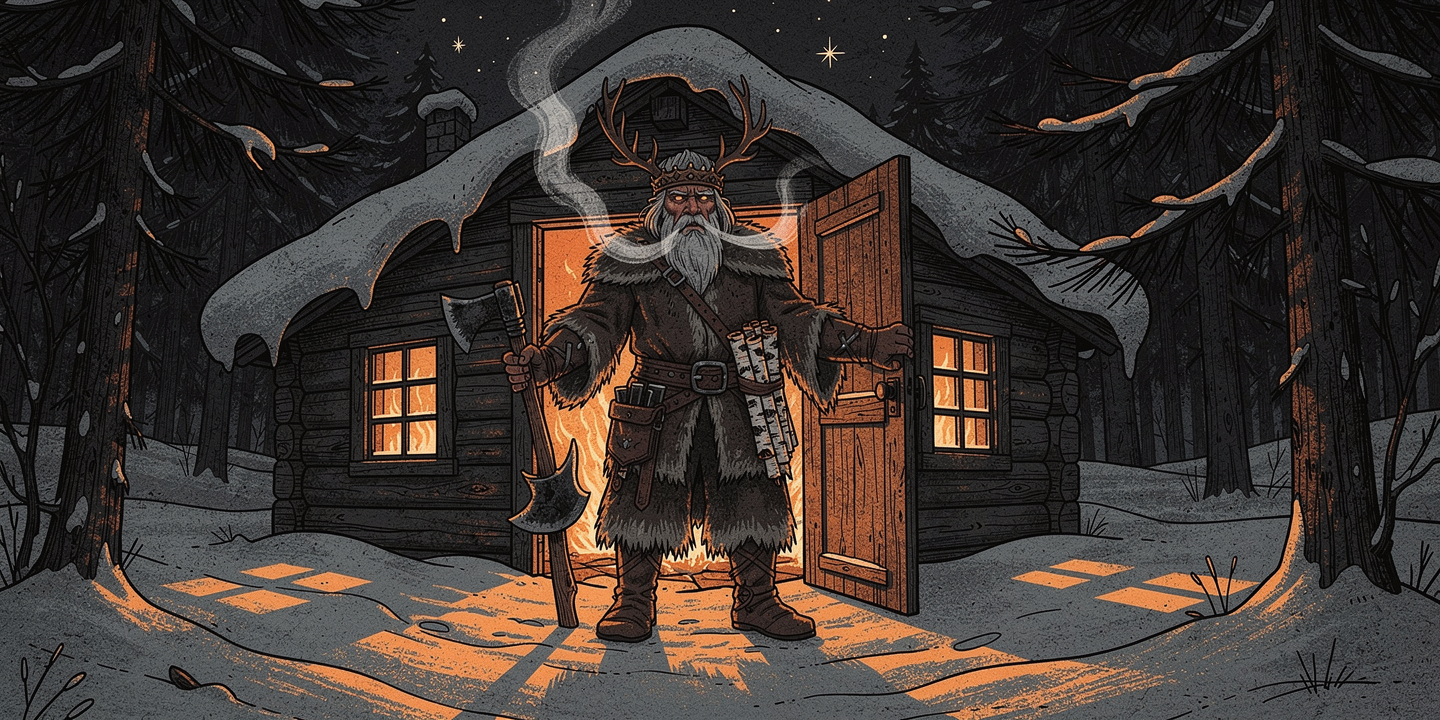
The midwinter elder who emerges from the comparative evidence is not merely kind. He is fierce. He judges. He carries a weapon—an axe, a hammer, birch rods—capable of cutting away what is dead so what is sound may survive. (That weapon now rests in Krampus’s hands, delegated to the shadow-companion when Christianity split the unified figure. But it was once his own.)
His generosity is not indiscriminate. It flows to those who have proven worthy through the year’s work, who have honored their obligations, who have kept the fires burning through the long dark.
This figure visits at the darkest moment because that is when judgment matters most. When resources are scarce, when survival is uncertain, when the community must decide what to preserve and what to sacrifice—then the fierce-generous elder arrives. He sees who has been naughty and who has been nice. He rewards and punishes accordingly. And then he disappears back into the dark, leaving his gifts by the fire that connects this world to the worlds beyond.
If such a figure once walked among us—whether as a historical person, a shamanic role, or a ritual enactment—his memory deserves recovery. Not because the soft modern Santa is wrong, but because the fierce elder speaks to something our culture has forgotten: that generosity and judgment are not opposites, but complements. That true kindness sometimes requires the axe. That the gift of survival is worth more when it is earned.
The name is lost. But when we hang stockings by the fire, when we leave offerings for the reindeer, when we wonder whether we’ve been naughty or nice—perhaps we remember, dimly, the one who came bearing judgment and gifts at the year’s turning.
Sources and Further Reading
Primary Scholarship
David W. Anthony, The Horse, the Wheel, and Language: How Bronze-Age Riders from the Eurasian Steppes Shaped the Modern World (2007). Essential for PIE dispersal and steppe corridor.
Mircea Eliade, Shamanism: Archaic Techniques of Ecstasy (1951/1964). Foundational comparative study; dated but still valuable.
Ronald Hutton, Stations of the Sun: A History of the Ritual Year in Britain (1996). Rigorous treatment of British seasonal customs.
J.P. Mallory & D.Q. Adams, Encyclopedia of Indo-European Culture (1997). Standard reference for PIE reconstruction.
M.L. West, Indo-European Poetry and Myth (2007). Authoritative linguistic reconstruction.
On Church Suppression and Pagan Survivals
Alain Dierkens, “Superstitions, christianisme et paganisme à la fin de l’époque mérovingienne” (1984). Analysis of the Indiculus superstitionum.
Bernadette Filotas, Pagan Survivals, Superstitions and Popular Cultures in Early Medieval Pastoral Literature (2005). Comprehensive study of penitential evidence.
Carlo Ginzburg, The Night Battles: Witchcraft and Agrarian Cults in the Sixteenth and Seventeenth Centuries (1966/1983). Groundbreaking work connecting Perchtenlauf to broader patterns.
Andrea Maraschi, “There is More than Meets the Eye: Undead, Ghosts and Spirits in the Decretum of Burchard of Worms” (2019). Analysis of 11th-century penitential evidence.
On Siberian Shamanism
Waldemar Bogoras, The Chukchee (1904-1909). Primary ethnography.
Ronald Hutton, Shamans: Siberian Spirituality and the Western Imagination (2001). Critical assessment.
Waldemar Jochelson, The Koryak (1908). Primary ethnography.
Piers Vitebsky, The Shaman (1995). Accessible overview.
On Alpine Traditions
Walter Grasser, Perchten, Krampus & Co. (2022). German-language scholarly treatment.
Al Ridenour, The Krampus and the Old Dark Christmas: Roots of the Festive Wild Man (2016). Popular but well-researched.
On PIE Thunder God
M.L. West, “The Indo-European Thunder God” in Indo-European Poetry and Myth. Chapter on *Perkwunos and descendants.
Jaan Puhvel, Comparative Mythology (1987). Standard treatment.
On Santa’s Development
Gerry Bowler, Santa Claus: A Biography (2005). Comprehensive popular history.
Adam C. English, The Saint Who Would Be Santa Claus (2012). Nicholas hagiography.
Stephen Nissenbaum, The Battle for Christmas (1996). Social history of American Christmas.
Critical Perspectives
Spencer Alexander McDaniel, “No, Santa Claus Is Not Inspired by Odin” (Tales of Times Forgotten, 2021). Important skeptical assessment.
Rebecca Watson, “No, Santa Wasn’t a Mushroom-Tripping Shaman” (Skepchick, 2022). Skeptical take on Siberian hypothesis.